Looking for the best exercise bike for home workouts in 2026? Most lists focus only on spin bikes — but after nearly two decades riding every type of indoor bike, I can tell you there’s way more to choose from. I’ve tested upright, recumbent, spin, air, and even folding bikes.
Every stationary bike in this guide is something I’ve personally ridden and reviewed. I didn’t just compare specs or copy from brand pages. I judged each one based on what actually matters when you’re sweating through a session: comfort, resistance quality, noise level, calorie burn, ease of use, build, and how well it fits your space and goals.
This isn’t a one-size-fits-all roundup. I picked the best bike in each category, from recumbents for rehab to spin bikes for fat burn, so no matter your fitness level, budget, or living space, there’s something here for you.
Not sure which type of bike fits your lifestyle? Scroll down for a side-by-side comparison chart and detailed buyer’s guide after the reviews.
Let’s dive in — I’ll help you find the right exercise bike that won’t end up as a clothes hanger.
Table of Contents
Best Exercise Bikes Compared Side-by-Side
| Feature | Schwinn 290 | Sole LCB | Keiser M3i | Schwinn AD7 | Inverapy | FitDesk 3.0 |
|---|---|---|---|---|---|---|
| Best For | Seniors, recovery, max comfort | Users in small apartments | Performance cyclists, Zwift users | Full-body HIIT, serious calorie burn | Rehab, full-body low-impact use | Compact homes, casual users |
| Impact Level | Lowest | Low | Medium | Highest | Lowest | Low |
| Workout Type | Lower body only | Lower body only | Lower body only | Full body (arms & legs) | Full body (arms & legs) | Lower body only |
| Calories Burned/Hour | 400–500 | 400–500 | 800–900 | 800–900 | 300–400 | 250–300 |
| Noise Level | Quiet | Quiet | Quiet | Loud | Quiet | Quiet |
| Space Needed | Large footprint | Small footprint | Medium footprint | Medium footprint | Large footprint | Small footprint |
| Resistance Type | Magnetic | Magnetic | Magnetic | Air | Magnetic | Magnetic |
| Preset Programs | 13 | 10 | None | 7 | None | None |
| Seat Comfort | Foam padded + backrest | Foam padded seat | Firm racing saddle | Replaceable, mid-firm | Wide seat with backrest | Cushioned seat with backrest |
| Adjustability | Fore/aft seat | Fore/aft + up/down seat | 4-way handlebar + seat | Fore/aft + up/down seat | Seat + arm movement | Up/down seat |
| Bluetooth/App Support | Yes (FTMS compatible) | Yes (FTMS compatible) | Yes (Zwift, Peloton, etc.) | No | No | No |
| Weight Capacity | 300 lbs | 350 lbs | 350 lbs | 350 lbs | 250 lbs | 250 lbs |
| Assembly & Maintenance | Easy, low maintenance | Very easy, minimal upkeep | Moderate, low maintenance | Moderate, belt & fan care needed | Simple, low maintenance | Very easy to assemble |
| Tablet/Desk Rack | Tablet holder | Tablet holder | Tablet holder | None | Tablet holder | Built-in desk |
| My Rating | 4.7/5 for comfort & ease | 4.6/5 for value | 4.6/5 for performance | 4.5/5 for HIIT training | 4.4/5 for rehab use | 4/5 for small spaces |
Schwinn 290 Recumbent Exercise Bike Review


| Feature | Details |
|---|---|
| Bike Type | Recumbent |
| Resistance | Magnetic (Class A watt precision) |
| Workout Programs | 13 Built-in |
| App Compatibility | JRNY (limited), Zwift (via QZ app) |
| Display | 7″ LCD (bright but times out at 30 mins) |
| Seat Comfort | Padded & ventilated, wide, non-tilting |
| Adjustability | Seat slides forward/back (not preset levels) |
| User Height Range | Fits up to 6’4″ (barely) |
| Weight Limit | 330 lbs |
| Noise Level | Virtually silent |
| Build Quality | Sturdy steel frame, heavy-duty |
| Dimensions | 66.4″ L x 28″ W x 47″ H |
| Weight | 107.6 lbs |
| Special Features | USB port, water bottle holder, Bluetooth speakers, tablet shelf |
I’ve personally used the Schwinn 290 for 9 months, clocking 45 to 60 minutes of riding at least five times a week — and it hasn’t missed a beat. This is one of the quietest, most stable, and smoothest pedaling recumbent bikes I’ve used in over a decade.
It replaced my old Schwinn 220, which served me faithfully for nearly ten years. I was skeptical about upgrading at first, but I can confidently say: the Schwinn 290 was the right call.
What I Like Most About the Schwinn 290 Exercise Bike
- Super smooth and silent ride – You won’t hear a thing even as resistance shifts.
- Solid frame and build – It’s heavy, but that’s what makes it feel rock-solid. I had no problem maneuvering it into place.
- Comfortable seat – It’s padded and ventilated, though I did add a cushion for longer rides. The sliding mechanism is easy to adjust.
- 13 built-in programs – You can hop on and get a real workout without needing a subscription.
- Bright display – Easy to read, with responsive buttons and clear programs.
- App compatibility – While JRNY is limited unless you pay, I fixed that by using the $5 QZ app, which now lets me use Zwift without a paid JRNY membership.
What I Don’t Like About the Schwinn 290 Exercise Bike
- Seat adjustment lever is stiff – Locking it down takes some effort.
- Some seat discomfort on long rides – I recommend a gel cover or small pillow if you’re bony like me.
- Assembly is okay… until it’s not – Seat assembly was overly complex and one section came with a misaligned screw hole that needed a longer screw.
- JRNY app locks key features behind a paywall – For example, speakers and built-in workout duration adjustments require membership. Thankfully, the QZ app solves that.
Who Should (and Shouldn’t) Buy the Schwinn 290
✅ Ideal for:
- Seniors or users recovering from injury
- Riders looking for a quiet, low-impact home cardio machine
- Tall users up to 6’4” and 330 lbs
- People who don’t want to rely on subscriptions to get value
- Those who want Zwift compatibility via third-party apps
❌ Not ideal for:
- Users who want backrest angle adjustments
- Those expecting fully unlocked JRNY features without paying
- People under 5’1” may find seat adjustment tricky
Final Verdict
If you want a reliable, comfortable, and quiet recumbent bike for home use, the Schwinn 290 is hard to beat at its price. Despite a few quirks with app integration and seat adjustments, the overall quality, smooth ride, and durability make this a solid long-term investment.
Sole LCB Upright Exercise Bike Review


Sole LCB Upright Exercise Bike
| Feature | Details |
|---|---|
| Bike Type | Upright |
| Resistance | Magnetic, 40 levels |
| Workout Programs | 10 preset, 12 user customizable |
| App Compatibility | Sole+ app (free for Sole owners) |
| Display | 9″ Backlit LCD with data transfer |
| Seat Comfort | Comfortable, angle-tilt capable |
| Adjustability | Height + seat tilt |
| User Height Range | Fits up to 6’4″ comfortably |
| Weight Limit | 350 lbs |
| Noise Level | Virtually silent |
| Build Quality | Heavy-duty frame, 27 lb flywheel |
| Dimensions | 60″ L x 25″ W x 60″ H |
| Weight | 112 lbs |
| Special Features | USB charging, Bluetooth, speakers, fan, tablet & phone holders |
After putting over 1000 miles on the Sole LCB upright bike, I can honestly say this machine is in a league of its own — especially for riders who want durability, high resistance options, and no monthly app fees. I tested both Sole upright bikes (LCB and B94), and while the B94 is solid, the LCB justifies its higher price with a smoother, quieter ride, heavier flywheel, and a far more capable touchscreen.
The LCB also has 20 more resistance levels which is way more than any rider I know would need. Then there is the Sole+ app, which is completely free, connects easily and tracks everything I care about — no JRNY or Peloton-style subscription traps here.
What I Like Most About the Sole LCB Stationary Bike
- Rock-solid stability – No wobble at all, even under high tension or high RPM sessions.
- Smooth, powerful resistance – The 27 lb flywheel delivers silky movement and challenge up to level 40.
- Clear display with app sync – The 9″ screen looks modern, works well, and connects seamlessly with the Sole+ app.
- Free app with useful metrics – Tracks your progress without asking for a monthly fee.
- Fully adjustable seating – I’m 5’5″ and found it easy to adjust the height and tilt for comfort.
- Quiet operation – I can ride without disturbing anyone, even on high resistance.
- Two Tablet Holder – I can use one shelf to place my tablet while placing my phone on the other holder.
What I Don’t Like About the Sole LCB Stationary Bike
- No power switch – You either keep the screen on or unplug after each use.
- Not ideal for carpet – On rugs with a mat underneath, there’s slight wobble, especially during fast cadence rides.
- Wireless phone charging is weak – The pad is too sensitive; my phone often slips out of position.
- Software UI could be smoother – Getting to custom workouts takes too many clicks; no way to favorite a custom program.
- Customer support is lacking – Sole didn’t respond to pre- or post-sale support inquiries.
Who Should (and Shouldn’t) Buy the Sole LCB
✅ Ideal for:
- Riders who want gym-quality feel without app subscriptions
- Heavier users (up to 350 lbs) looking for stability
- Users who value smooth pedaling with high resistance range
- Taller users up to 6’4”
- Endurance trainers wanting full control of their workouts
❌ Not ideal for:
- Carpet-only rooms without a solid base
- Users who rely heavily on app interactivity
- Riders under 5’1” may find reach or seat settings limiting
Final Verdict
The Sole LCB is everything I wanted in an upright bike — durable, smooth, quiet, and app-compatible without requiring a subscription. It outperforms most mid-range bikes in its class with its heavy flywheel, high resistance range, and solid feel. While there are small quirks in software and support, the riding experience is consistently excellent. If you want a no-BS, studio-grade upright bike that won’t lock you into an ecosystem, this is it.
Keiser M3i Indoor Cycling Spin Bike Review


Keiser M3i Indoor Cycling Bike
| Feature | Details |
|---|---|
| Bike Type | Indoor Cycling / Spin |
| Resistance | Magnetic, 24 levels (manual) |
| Workout Programs | None built-in (BYOD via apps) |
| App Compatibility | Zwift, Peloton, Keiser app, QZ |
| Display | Backlit LCD, Bluetooth-enabled |
| Seat Comfort | Firm performance saddle (replaceable) |
| Adjustability | 4-way seat + vertical handlebar |
| User Height Range | 5’0″ to 7’0″ |
| Weight Limit | 350 lbs |
| Noise Level | Very quiet (belt + magnetic system) |
| Build Quality | Made in the USA, heavy-duty frame |
| Dimensions | 49″ L x 26″ W x 45″ H |
| Weight | 85 lbs |
| Special Features | Dual-sided pedals (SPD + cages), app freedom, no subscription required |
After testing and riding dozens of indoor bikes, the Keiser M3i is hands down the best spin bike I’ve used long-term — and that’s exactly why I included it in this roundup of the best exercise bikes. For over three years, I’ve been riding this bike up to five times per week, and it’s never let me down.
The magnetic resistance is incredibly smooth, and although the flywheel is only 8 lbs, the gear ratio makes it feel like you’re climbing hills and sprinting flats with perfect transitions. This is a spin bike made for serious cyclists and everyday riders alike.
Assembly? Took me under an hour, solo. Everything was packaged neatly and tools with maintenance kit were included (only the Bundle). The build quality impressed me from the first bolt to the final pedal install.
What I Like Most About the Keiser M3i Spin Bike
- Top-tier build quality – It’s solid, sleek, and engineered for real-world use. Looks pro, feels pro.
- Zero subscriptions required – I paired it with Zwift and Peloton using the QZ app and stream content without being locked into any paid platform.
- Super quiet – Magnetic resistance + Poly-V belt = near-silent rides, even during high RPM sprints.
- Compact and lightweight – Easy to move and takes up less space than most upright or recumbent bikes.
- Dual-sided pedals – SPD clips + toe cages included. Ride with or without cycling shoes.
- Perfect adjustability – Fits me at 6’0” and my friend who’s 5’2″. Great for households with multiple users.
- Made in the USA – High-quality design and long-term durability.
What I Don’t Like About the Keiser M3i Spin Bike
- No built-in programs or screen – You need your own tablet or phone for streaming workouts.
- No auto-adjust resistance – Unlike Peloton+ or NordicTrack, it won’t change resistance automatically during guided rides.
- Seat can be firm for longer sessions – I swapped it for a wider saddle after year one.
- No power zone on the monitor – You’ll need to use the Keiser M app on your phone/tablet to see the Power Zone.
Who Should (and Shouldn’t) Buy the Keiser M3i
✅ Ideal for:
- Cyclists who want a commercial-grade ride with full app freedom
- Households with multiple users (fits a wide height range)
- Riders who don’t want to pay monthly to access workout programs
- Zwift or Peloton fans who want to use their own device
- Anyone looking for a reliable spin bike that’ll last a decade
❌ Not ideal for:
- Users who want a built-in screen or automated resistance
- People expecting built-in workouts or entertainment
- Those who prefer upright or recumbent bikes for easier mounting
Final Verdict
The Keiser M3i isn’t trying to be everything to everyone — and that’s what makes it excellent. It’s a purpose-built spin bike, designed to deliver a quiet, smooth, and powerful ride with complete freedom to use your favorite apps. It’s not cheap, and it won’t adjust resistance automatically. But if you want a long-lasting, studio-quality indoor cycle that puts you in control, the M3i delivers in every way that matters. If I had to pick one spin bike to own for the next 10 years, this is the one.
Schwinn AD7 Airdyne Exercise Bike Review

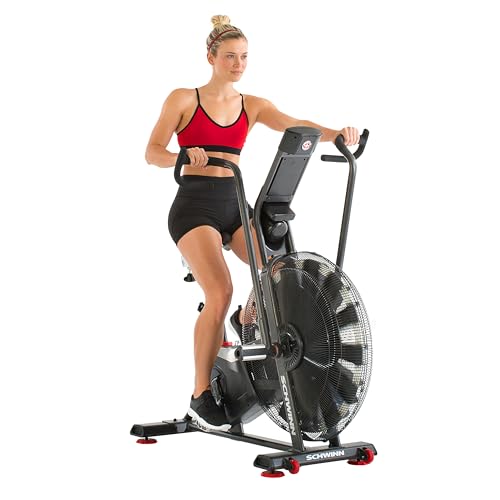
Schwinn AD7 Airdyne Exercise Bike
| Feature | Details |
|---|---|
| Bike Type | Air Bike (Arm + Leg) |
| Resistance | Air (dynamic fan resistance) |
| Workout Programs | 9 Built-in (Intervals, HR, etc.) |
| App Compatibility | None (manual tracking only) |
| Display | LCD (non-backlit, battery-powered) |
| Seat Comfort | Large, padded, 4-way adjustable |
| Adjustability | Vertical & fore/aft seat adjustments |
| User Height Range | 5’0″ to 6’6″ (approx.) |
| Weight Limit | 350 lbs |
| Noise Level | Moderate (wind noise from fan) |
| Build Quality | Steel frame, commercial-grade |
| Dimensions | 53″ L x 26.5″ W x 53″ H |
| Weight | 113 lbs |
| Special Features | Multi-grip handles, dual-action arms, phone/bottle holder |
I picked up the Schwinn AD7 when I was craving a no-nonsense full-body burner that could hold up to daily HIIT sessions. I’ve used it 2-3 days a week for the last six months and this thing delivers intensity like no magnetic or recumbent bike ever could.
From the moment I got it, the build quality stood out — heavy, sturdy, and clearly made to last. I assembled it solo in under an hour, but a second pair of hands would’ve made routing the console wires easier. I ordered the A/C adapter separately and recommend you do the same — battery power isn’t ideal.
The air resistance system is self-scaling — meaning the harder you go, the tougher it gets — making it perfect for intervals. And because it targets both your upper and lower body simultaneously, calorie burn is through the roof.
It’s not whisper-quiet like the Keiser M3i or Schwinn 290, but that’s part of its character. The whoosh of the fan doubles as built-in cooling — no need for a separate fan in your workout room.
What I Like Most About the Schwinn AD7 Air Bike
- Unlimited resistance scaling – There’s no ceiling. You control the intensity based on how hard you push.
- Total-body activation – Legs and arms both engage with every pedal stroke and pull.
- Multi-grip handlebars – Comfortable hand positioning for any style of ride or rehab.
- Smooth belt drive – No chain lash, minimal maintenance, and very quiet for an air bike.
- Footrests – Great for isolating upper body if you’re recovering from a leg injury.
- Heavy-duty feel – It’s stable even during all-out sprints at high RPMs.
- 9 useful programs – Interval-based presets are actually worth using.
What I Don’t Like About the Schwinn AD7 Air Bike
- No Bluetooth or app sync – You’ll need a separate fitness tracker if you want to log data.
- Seat is mediocre – I swapped mine out for a memory foam saddle after 3 weeks.
- Monitor not backlit – Hard to read in low light unless you use a clip-on light.
- Heart rate monitor limitations – Only supports uncoded 5kHz straps, and finding a compatible one can be frustrating.
Who Should (and Shouldn’t) Buy the Schwinn AD7
✅ Ideal for:
- HIIT fans who want maximum calorie burn in 20–30 minutes
- Users seeking upper + lower body cardio in one device
- Heavier riders up to 350 lbs
- Rehab-focused users needing adjustable handlebars and smooth resistance
- Anyone wanting a low-tech, high-impact cardio option
❌ Not ideal for:
- People wanting app connectivity or workout tracking
- Users sensitive to noise — the fan makes itself known
- Those who prefer a laid-back, low-impact ride
Final Verdict
The Schwinn AD7 is a powerhouse for interval training and full-body cardio. It doesn’t have flashy screens or app support, but it makes up for that with raw functionality, a rock-solid build, and serious workout potential. If you’re hunting for a no-frills air bike that can take a beating and dish it right back, the AD7 is a worthwhile investment.
Inverapy Trainer with Arm and Leg Motion Review


| Feature | Inverapy RCT2025 |
|---|---|
| Resistance Type | Manual Magnetic |
| Resistance Levels | 8 Levels |
| Drive Mechanism | Belt Drive |
| Seat Type | Oversized Recumbent w/ Backrest & Belt |
| Swivel Seat | Yes |
| Pedals | Ergonomic Foot Pedals with 3 Positions |
| Arm Movement | Yes (Dual – Moving & Fixed) |
| Handlebars | Adjustable Length, Non-Slip |
| User Height Range | 5’1” to 6’2” |
| User Weight Capacity | 350 lbs |
| Display Console | Basic LCD (Battery Powered, Non-Backlit) |
| Bluetooth/App Sync | No |
| Workout Programs | None (Manual Control Only) |
| Assembly Time | 1–2 Hours (2-Person Recommended) |
| Footprint (L x W x H) | 53” x 35.8” x 45.7” |
| Bike Weight | 132 lbs |
| Best For | Seniors, Rehab, Mobility-Limited Users |
| Not Ideal For | HIIT or App-Connected Interactive Workouts |
I’ve tested dozens of rehab and recumbent exercise bikes over the years, and the Inverapy RCT2025 was a surprisingly capable machine that blends upper and lower body cardio with real accessibility. If you’re looking for a bike that caters to rehab, low-impact full-body movement, or physical limitations, this might be the perfect fit.
This machine feels like it was built with real care and intent – every single part of it is adjustable, and that’s what makes it a total standout for recovery workouts. In our family, we all fit on it perfectly, from shorter to taller users, without needing to compromise comfort. The swivel seat not only slides forward and backward but actually rotates left and right, which made getting on and off the bike incredibly easy for me – no more awkward leg swings or risking balance issues just to sit down.
The fixed handlebars adjust fore and aft, the moving handlebars can be repositioned, the pedals offer multiple leg extension angles, and even the leg harness tightens up to fit different users securely. The saddle itself adjusts, of course, so no matter who hops on, it just works. This level of adjustability means I never had to lean uncomfortably or stay in a poor position during recovery – which is crucial when you’re dealing with joint issues or post-surgery limitations. No, it’s not a flashy Peloton rival, but it’s a thoughtful, inclusive, and rehab-friendly machine that genuinely puts the user first.
What I Like Most About the Inverapy Arm & Leg Exercise Bike
- Swivel Seat: Super convenient for getting on and off, especially for users with mobility issues.
- Leg Harness & Seat Belt: Great safety design that secures legs during use without discomfort.
- Dual Handles: You get moving arms for total-body workouts and stationary grips for support.
- Pedal Adjustability: 3 pedal angles help you target specific joints and muscles.
- Solid Construction: Supports up to 350 lbs and feels very stable even at intense paces.
- Tablet Holder: Holds my 12.9″ iPad with no wobble.
- Ideal for Recovery: Especially helpful for people with MS, arthritis, post-surgery recovery, or limited strength/balance.
What I Don’t Like About the Inverapy Arm & Leg Exercise Bike
- Console is Outdated: No Bluetooth, backlight, or preset programs.
- Manual Resistance: No electronic controls, and adjusting intensity mid-workout isn’t seamless.
- Backrest Angle Fixed: Would benefit from a tiltable backrest for better lumbar support.
- Not Ideal for Advanced Athletes: If you want hardcore HIIT or virtual ride integration, this isn’t it.
Who Should (and Shouldn’t) Buy the Inverapy
✅ Who it’s perfect for:
- Seniors or those recovering from surgery or injury who need low-impact, joint-friendly workouts.
- Users with limited mobility who benefit from the easy step-through frame, swivel seat, and supportive grips.
- People managing conditions like MS, arthritis, or balance issues—the safety and adaptability features shine here.
- Anyone needing gentle full-body cardio without stressing the joints—thanks to the arm/leg combo movement and ergonomic pedal design.
- Home users seeking a semi-recumbent rehab bike that doesn’t cost $4,000+ like some of the commercial-grade alternatives.
❌ Who might want to skip it:
- Expecting an adjustable backrest or resistance control from the handles – features like those are missing and might make more advanced users feel limited.
- Looking for high-intensity HIIT sessions or calorie-shredding workouts – air bikes like the Schwinn AD7 or magnetic spin bikes like the Keiser M3i are better suited for that.
- Wanting smart tech and app integration – there’s no Bluetooth, backlit screen, or pre-programmed workouts here.
My Final Verdict
Despite some limitations with the display and manual resistance control, the Inverapy RCT2025 nails what it’s built for: safe, comfortable, therapeutic full-body cardio. It’s not trying to compete with fancy smart bikes — and that’s what makes it so good at what it does. It’s the kind of machine I’d recommend to my own family members in recovery.
FitDesk 3.0 Folding Exercise Bike Review


FitDesk 3.0 Folding Desk Exercise Bike
| Feature | Details |
|---|---|
| Bike Type | Folding Upright (with desk) |
| Resistance | Manual Magnetic (8 levels) |
| Workout Programs | None |
| App Compatibility | None |
| Display | Basic LCD (non-backlit) |
| Seat Comfort | Wide but firm, vertically adjustable |
| Adjustability | Seat height, desk depth, pedal straps |
| User Height Range | 5’1″ to 6’2″ (with seat extender) |
| Weight Limit | 300 lbs |
| Noise Level | Extremely quiet |
| Build Quality | Lightweight steel frame |
| Dimensions | 28″ L x 16″ W x 45″ H |
| Weight | 45 lbs |
| Special Features | Integrated desk, under-desk drawer, resistance bands |
I picked up the FitDesk 3.0 folding exercise bike to sneak in more movement while working from home, and after a year of pedaling through emails and meetings, I can say it’s delivered exactly that. It’s not built for hardcore workouts – even at max resistance, my heart rate barely climbs – but that’s not the point.
This bike is about convenience, quietness, and productivity. The oversized desktop fits my 15″ laptop and notepad comfortably. There’s also a hidden drawer underneath, which is surprisingly useful for storing my phone or AC remote. Plus, the bike folds up quickly and is super light, which helps in my cramped home office setup.
If you’re looking to hit VO2 max or crush intervals, this isn’t your tool. But if your goal is to reduce sedentary time while getting actual work done, the FitDesk 3.0 is a smart buy.
What I Like Most About the FitDesk 3.0 Folding Exercise Bike
- Large, secure desktop – Great for laptops, tablets, or even sketch pads
- Smooth magnetic pedaling – Incredibly quiet and ideal for multitasking
- Folds up fast – Compact and light, easy to tuck into a closet
- Integrated drawer + strap – Perfect touches for working professionals
- Solid build for the price – Holds up even after hundreds of miles
- Low barrier to use – Jump on and go, no power or app setup needed
What I Don’t Like About the FitDesk 3.0 Exercise Bike
- Resistance is minimal – Even level 8 is low-effort cardio
- Seat is hard – I had to use a third-party gel cushion for comfort
- Desk doesn’t adjust far enough forward – Causes some slouching while typing
- Armrests are in the way – Removed mine to type more freely
- Display is basic and dim – No Bluetooth, no backlight, no programs
Who Should (and Shouldn’t) Buy the FitDesk 3.0
✅ Ideal for:
- People working from home who want to stay moving
- Anyone with limited space needing a compact exercise bike
- Users who want light cardio without changing clothes or breaking a sweat
- Riders under 6’2″ looking for comfort + laptop support
❌ Not ideal for:
- Cyclists who want high resistance or interval-style training
- Users sensitive to firm seats
- Anyone expecting full back support or backlit console tracking
Final Verdict
The FitDesk 3.0 Folding Bike isn’t going to push your cardio to the limit, but it’s not meant to. It’s a functional, ultra-quiet desk bike for people like me who want to move more without disrupting the workday. It folds up small, rides smoothly, and lets you work and pedal at the same time. For staying active at your desk, it’s one of the most useful tools I’ve tested. ’Id recommend it in a heartbeat for any work-from-home setup.
What I Look for When Testing & Choosing Exercise Bikes
| Bike Type | Best For | Avg. Calories/hr | Noise Level | Space Needed |
|---|---|---|---|---|
| Recumbent Exercise Bikes | Rehab & Seniors | 300–500 | Low | Large |
| Upright Exercise Bikes | General Fitness | 400–600 | Low | Medium |
| Spin Exercise Bikes | HIIT & Athletes | 600–900 | Low | Medium |
| Stationary Air Bikes | HIIT & Full-body | 500–900 | High | Large |
| Arm + Leg Exercise Bikes | Therapy, Rehab | 300–400 | Low | Large |
| Folding Exercise Bikes | Small Spaces & Light Use | 200–300 | Very Low | Very Small |
Which Exercise Bike Is Best for You? Let’s Break It Down
- Resistance Type & Range: Magnetic is quieter; air is tougher.
- Seat Comfort & Adjustability: Crucial for long rides or injury recovery.
- Bluetooth & App Compatibility: Great for syncing with Zwift, Kinomap, or Peloton Digital.
- Storage & Portability: Especially for folding or compact options.
- Build Quality: A sturdy frame and solid pedals make all the difference.


If you’re still unsure which exercise stationary bike to get after reading my six in-depth reviews, this guide is for you. I’ve tested all types personally – recumbent, spin, upright, air, folding, and arm/leg combos – and here’s how to choose the one that fits your goals, space, and fitness level.
Recumbent Exercise Bikes

When it comes to buying a recumbent exercise bike, there are a few things you should keep in mind. First, consider your comfort level. Recumbent bikes are designed to be more comfortable than upright or spin bikes, with a seat that allows you to recline and support your back. Look for bikes with adjustable seats and adjustable backrest to ensure a proper fit. The Nautilus R618 which I reviewed in this article has them both, plus a gel cushion for extra comfort.
Another important factor to consider is resistance. You want a bike with adjustable “electronic resistance” so you can tailor your workout to your fitness level. Some bikes have built-in resistance controls on the handlebars, which can be a convenient feature. Look for bikes with a variety of resistance levels, so you can gradually increase your workout intensity over time. Again, Nautilus R618 has both, electronic resistance and resistance controls on the handlebars so you don’t need to lean forward for chasing intensity.
It’s also important to consider the monitor. A good monitor will be backlit, easy to read, and ideally have Bluetooth FTMS connections (like Nautilus R618) and preset workout programs to choose from. This will help you track your progress and stay motivated. Plus, a good monitor allows connecting to online cycling apps like Zwift.
Finally, it’s worth noting that recumbent bikes are different from spin bikes and upright bikes. Recumbent bikes are designed to be more comfortable and easier on the joints, making them a good choice for those with mobility issues or injuries. With up to 500 calories, they burn fewer calories compared to spin bikes or upright bikes but they are also easier to use. Remember to get one like Nautilus R618 that has a step-through design for easy mounting and dismounting.
Want to see more options like the Schwinn 290? Check out my full roundup of the best recumbent exercise bikes.
Upright Stationary Bikes

From the exercise bikes that I tried and reviewed in this article if you decide to buy an upright exercise bike, there are a few key things to look out for. Firstly, adjustable components are crucial for ensuring a comfortable ride. Look for bikes with 4-way adjustable seats and tilting adjustable handlebars to accommodate people of all shapes and sizes. The actual comfort of the seat is not a dealbreaker because you can always replace the saddle but it’s a + to have a gel comfortable saddle like Nautilus U618 upright bike.
A backlit monitor with preset workout programs is also a desirable feature to have, as it will help you track your progress and keep you motivated. Aside from a backlight console, a Bluetooth FTMS transmitter is also important because without it you wouldn’t be able to sync the bike with Peloton, Kinomap, or my favorite cycling app Zwift. The Nautilus U618 has this feature in case you end up buying that exercise bike.
It’s also important o know that upright exercise bikes are different from both recumbent and spin bikes. Unlike recumbent exercise bikes that you lean backward, upright bikes have a straight, upright riding position that requires more balance and core engagement. They also don’t offer the same level of back support as recumbent bikes, and you need to be able to stand on one leg to cross over the bike.
In comparison to indoor cycling spin bikes where you need to lean a little forward while cycling, upright exercise bikes are less intense and don’t require you to lean forward. So, you don’t lean forward like spin bikes or backward like recumbent bikes. But you stay in an upright position while doing your cardio workout on an upright bike.
Overall, upright exercise bikes are a great option for those who want a more challenging workout than recumbent bikes can offer, without the high-intensity of spin bikes. With adjustable components like a tablet holder to watch a nice program and a comfortable seat, an upright stationary bike can provide a great low-impact cardio workout. Just keep in mind that you can’t stand on the pedals like you would on a spin bike so during the entire cycling session, you need to remain seated when using an upright exercise bike.
For more upright picks beyond the Sole LCB, I’ve reviewed several others in this best upright exercise bikes guide.
Spinning Exercise Bikes

If you decided to buy an indoor cycling spin bike as an exercise bike, there are a few things you should look for to ensure you’re getting the best machine for your needs. Firstly, adjustable handlebars are a must, ideally with 4-way adjustability to ensure a comfortable riding position. Additionally, a backlit monitor with Bluetooth capabilities that tracks watt, speed, and RPM is essential if you’re planning to follow online indoor cycling classes.
Clip-in pedals are also an excellent feature to look out for, as are magnetic resistance systems with belt drives for a quieter workout. A great example of a spin bike that ticks all these boxes is the Keiser M3i.
Compared to upright and recumbent exercise bikes, spin bikes are designed to mimic the feel of a real road bike, with pedals that are often similar to those found on road and mountain bikes. However, this means the riding position is more aggressive, so you need to lean forward rather than sit upright or recline.
The seats on spin bikes are also smaller and have less cushioning, with no backrest like on a recumbent bike or a larger seat like an upright bike. This is because spin bikes are designed for high-intensity performance, which requires minimum friction between the saddle and the rider to prevent bruising.
Also, spin bikes often have heavier flywheels, which means there is more resistance so you’ll need to be stronger or push harder compared to other types of stationary bikes. It’s no secret that a 50-lb flywheel on a spin bike needs more strength than a 10-lb flywheel which is often found recumbent and upright exercise bikes.
While spin bikes are not as comfortable as other stationary exercise bikes, they can burn up to 900 calories per hour, making them an excellent choice if you’re looking for a quicker way to see results. However, they’re not recommended for everyone, particularly elderly people, those in recovery, or people with bad knees, due to their higher impact and difficulty of use.
Ultimately, the main difference between spin bikes and other types of stationary exercise bikes is in the intensity of the workout and the muscle groups targeted. Spin bikes are designed for high-intensity interval training and can target the glutes, hamstrings, and calves more effectively than upright or recumbent bikes. So, it’s very important to consider your fitness level and personal needs before investing in a spin bike.
Serious about spin? Dive into my in-depth reviews of the best indoor cycling bikes for home.
Navigate Air Exercise Bikes

When you’re on the lookout for an air exercise bike, there are some important features to keep in mind. First things first, these bikes are great for HIIT workouts, so it’s a good idea to find one that comes with preset programs to help you get the most out of your workouts. For example, the Assault bikes have interval programs (2-minute exercise, 30-second rest, etc).
You’ll also want to look for a monitor that can track important metrics like heart rate, distance, and time. Some air bikes even come with additional elements like footrests that allow you to work out different parts of your body independently because sometimes you don’t want your legs to rest while using your arms and shoulder.
Now, when it comes to handlebars, it’s important to find an air bike that has dipped multi-grip handlebars so you can switch up your grip and work different muscles in your arms and shoulders. Unfortunately, a lot of air bikes come with straight bars that only give you one grip option. In addition, look for a bike with a tablet holder and grippy metal pedals without cages (no cheap plastic ones!), so you can easily move your feet between the footrest and the pedals while pedaling.
When it comes to transmission, the timing belt is your best option, but a chain isn’t too shabby either. Sure, chains can be loud, but you probably won’t even notice because the air bike itself is pretty noisy. Lastly, a comfortable seat is always a plus. Remember that you’ll be seated the whole time you’re on an air exercise bike, so finding a gel seat can be a nice touch. But, if the bike you like doesn’t come with a comfortable seat, don’t worry too much – you can always replace it later with a comfortable air bike saddle.
An air exercise bike features a large fan blade that creates resistance as you pedal as a result they are the loudest type of exercise bike that you can own. Upright bikes, spin bikes, and recumbent exercise bikes use magnetic resistance which makes zero noise so they are way more apartment friendly than air exercise bikes.
In terms of design, air bikes are completely different too. They have handlebars which is something you don’t get with other types of indoor exercise bikes. So, instead of using only your legs, you can also engage your arms and shoulder when using air exercise bikes and get additional benefits.
So, air exercise bikes offer a high-intensity full-body workout that can improve cardiovascular health, particularly the upper body, and core, as the resistance of the fan blade requires effort from the arms and shoulders as well as the legs.
As with every other exercise bike, calories burned will vary based on factors like age, weight, and workout intensity, but generally speaking, air exercise bikes and spin bikes can burn up to 900 calories per hour, while upright bikes and recumbent bikes burn fewer calories, around 400-600 per hour.
I’ve also compared top-rated fan bikes in this detailed list of the best stationary air bikes.
Recumbent Cross Trainer

For recumbent bikes like Teeter, you’ll want to look for stationary bikes that can exercise your arms and legs independently. Obviously, a comfortable seat is key for these, since you’ll be sitting on it a lot. Tablet holders and other elements on the console are also ideal.
Generally speaking an arm and leg recumbent exercise bike is designed to allow users to exercise both their arms and legs independently. This means that the bike has both pedals and handlebars that can be used simultaneously, providing a full-body workout.
These stationary bikes are ideal for individuals who want to engage in lowest-impact cardiovascular exercise, build upper and lower body strength, and improve their overall fitness.
However, I normally don’t recommend them if you are in good shape and want quick results. Due to their comfort and low-impact design, arm and leg recumbent exercise bikes burn less than 400 calories per hour which is significantly less compared to spin bikes and air exercise bikes.
In contrast, a traditional leg recumbent exercise bike only has pedals that the user can use to exercise their lower body. These bikes are generally designed to provide a comfortable and low-impact workout that targets the legs, hips, and glutes. They are ideal for individuals who want to engage in low-impact cardiovascular exercise, improve their leg strength and endurance, and burn calories.
The main difference between the two types of exercise bikes is that the arm and leg recumbent exercise bike allows users to work out their upper body, while the traditional leg recumbent exercise bike only allows users to work out their lower body.
If you’re specifically looking for exercise bikes that target both upper and lower body, check out the best recumbent exercise bikes with arm workouts.
Folding Exercise Bikes

Just like any other exercise bike, there are several important features to consider when it comes to buying a folding exercise bike. Firstly, as the name suggests, a folding design is crucial. This allows the bike to be easily stored in smaller spaces, such as behind a curtain or in a closet, when not in use. Additionally, the exercise bike should be lightweight and easy to move around, as this will make it more convenient to use and store.
Another important feature to consider is the bike’s design. Good folding exercise bikes typically come in 2-in-1 adjustable designs: upright and recumbent. Upright bikes mimic the experience of riding a traditional bicycle, while recumbent bikes offer a more relaxed, seated position.
Some additional features that are often included in folding exercise bikes include a set of handlebars next to the saddle, a backrest, a tablet holder for entertainment while working out, as well as resistance bands for an upper body workout. These can be great additions that enhance the overall workout experience.
Aside from the compact design, lightweight, and space-saving design folding exercise bikes tend to be more affordable than other types of exercise bikes, making them a great option for those on a budget.
However, there are also some downsides to consider with folding exercise bikes. For example, folding exercise bikes are not as sturdy or durable as other types of exercise bikes, and may not offer the same level of comfort during use. Additionally, because they are designed to be compact and lightweight, they are not suitable for heavier or more intense workouts.
When comparing folding exercise bikes to other types of exercise bikes, such as spin bikes, recumbent exercise bikes, and upright bikes, there are several key differences to keep in mind. Folding exercise bike don’t offer much of resistance and aren’t as pleasant to pedal as other exercise bikes, especially for longer rides. Plus, folding exercise bikes can help burn a maximum of 300 calories per hour which is much less than traditional upright exercise bikes.
Spin bikes on the other hand are designed for high-intensity, indoor cycling workouts and typically offer a more immersive experience. Recumbent exercise bikes offer a more relaxed seated position and are often more comfortable for those with back or joint pain. Upright bikes mimic the experience of riding a traditional bicycle and are great for cardiovascular workouts.
So, I only recommend a folding exercise bike if you are on a tight budget and you live in a very small apartment where you normally need to move the bike after each use. Otherwise, you should stick with an upright or spin bike.
Looking for a compact ride? See more picks in my roundup of the best folding exercise bikes.
Final Verdict: Which Exercise Bike Should You Get?
Choosing the best exercise bike really comes down to your fitness goals, available space, physical condition, and honestly — how you like to work out. I’ve personally tested every single stationary exercise bike I listed above, and they each shine for different users. Whether you’re recovering from an injury, trying to lose weight, or just want to stay active without leaving home, there’s an exercise bike here that’ll fit your needs like a glove.
🚴♂️ My Quick Picks:
• For comfort-focused upright workouts: Schwinn 290 Recumbent Bike
• For low-impact cardio & solid build: Sole LCB Upright Bike
• For HIIT & power users: Keiser M3i Indoor Cycle
• For intense full-body workouts: Schwinn AD7 Air Bike
• For rehab & joint recovery: Inverapy RCT2025 Arm + Leg Bike
• For tight budgets & small spaces: FitDesk 3.0 Folding Bike
Still unsure which bike is best for you? Drop me a comment or shoot me a message — I’ll help you choose the right exercise bike based on your space, budget, and fitness level. I reply to every single question because I know how overwhelming it can be to make the right pick.
Which Exercise Bike Burns the Most Calories?
From my experience testing all types, spin bikes like the Keiser M3i are the top calorie-burners. I can hit up to 900 calories in a high-intensity 45-minute ride. Air bikes come close, but they’re louder and not as app-friendly. If fat loss is your main goal, spin bikes win hands down.
Best Exercise Bike for Bad Knees or Joint Pain?
I’ve recommended recumbent bikes like the Nautilus R618 to several readers with knee issues—and it’s the same one I’d use if I had joint pain. The reclined seat, step-through frame, and low-impact pedaling make it the most joint-friendly bike I’ve used. Just make sure it has good back support and magnetic resistance for smoother motion.
Are Folding Exercise Bikes Good for Daily Workouts?
I’ve tested a few, including the FitDesk 3.0, and while they’re super convenient for small spaces, I wouldn’t rely on them for daily intense workouts. If you’re just starting out or live in a tiny apartment, sure. But if you’re cycling daily for cardio or fat loss, I’d recommend stepping up to an upright or spin bike.
Upright vs Spin Bikes: Key Differences Explained?
I’ve spent months riding both and here’s the main difference: upright bikes feel more like a casual city bike – you stay seated and it’s more relaxed. Spin bikes, on the other hand, are made for intensity. You lean forward, stand up, and push hard. If you’re into group classes or Zwift, spin bikes give you that studio vibe. Uprights are better for everyday cardio without going all-out.
Do You Need Bluetooth on an Exercise Bike?
For me, Bluetooth FTMS is a must-have. It’s what lets me connect my bike to Zwift or Peloton Digital for more engaging workouts. Without it, you’re stuck with basic metrics and can’t keep track of your weekly or monthly progress. If you like structured training or just want to stay motivated, make sure the bike supports app sync. If you rather watch Netflix, TV, or Youtube while cycling, then Bluetooth is not really a factor.
Can Stationary Bikes Help Burn Belly Fat?
Yes, absolutely – but it depends more on consistency and intensity than the bike type. Personally, I burned the most belly fat using a spin bike 4–5 times a week with a mix of steady rides and intervals. Just remember: no bike targets belly fat directly, but it helps burn overall fat which includes the belly.
What’s the Best Compact Exercise Bike for Small Spaces?
The folding bikes like the FitDesk 3.0 take up the least room—I can slide it behind a curtain when I’m done. But upright bikes are a good middle-ground too. Recumbent and air bikes need the most space. If your home gym is tight, folding is the way to go.
Disclaimer: I personally tested every bike featured in this guide to help you make the most informed decision. Some links may earn me a small affiliate commission at no extra cost to you. Learn more.
